Why fakes are common
Signed shirts sell at a premium over unsigned ones, and that premium is exactly what tempts forgers. A replica shirt costs a fraction of a signed one, and a decent forged signature can be added in seconds. Add online marketplaces where anyone can list anything, and buyers often can't check what they're getting.
There's a problem of scale too. Players sign huge numbers of items over a career, at club events, charity nights and in the street. Signatures vary from one day to the next, so a forger has plenty of genuine examples to copy and a ready excuse for any differences.
No check is foolproof. What you can do is stack up evidence, and be wary when there isn't any.
Certificates of authenticity and what they prove
A certificate of authenticity (COA) is a piece of paper, or a card, saying the signature is genuine. Sounds reassuring. But a COA is only as good as whoever issued it.
A COA from an anonymous seller proves nothing, because anyone can print one. It's more useful when it comes from a named company or person you can contact, who states where and when the item was signed, and who is prepared to stand behind that claim. Even then, it's a statement about the signing, not a guarantee about the shirt itself.
Look for these points:
- Who issued it, and can you actually reach them?
- Does it say when and where the signing took place?
- Does it identify the specific item, for example with a unique number that matches a tag or sticker on the shirt?
- Is there a photo of the signing?
If the answer to most of those is no, treat the certificate as decoration.
Photo-match evidence
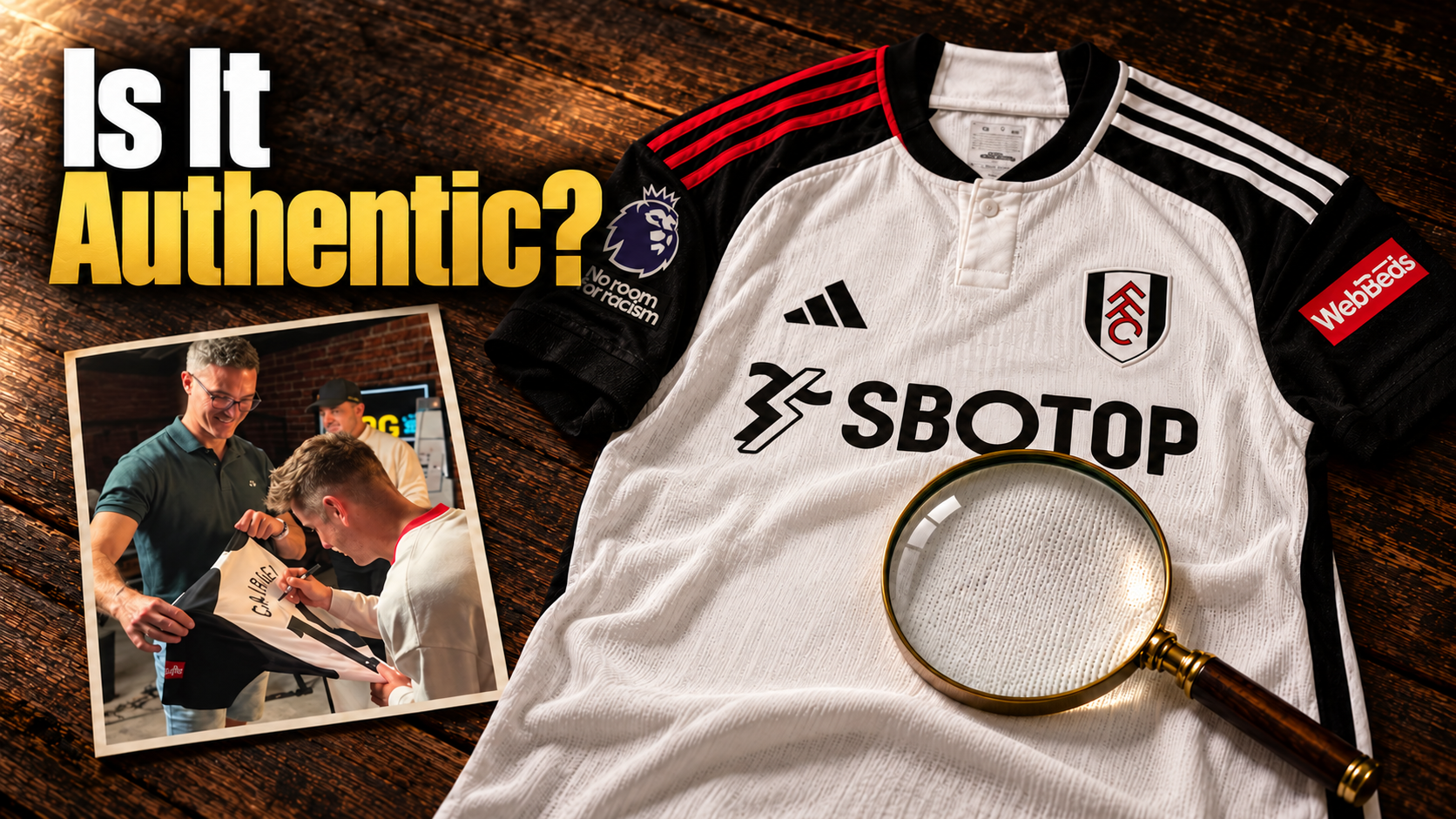
Photo evidence is the strongest thing a seller can offer. The best version is a picture of the player signing the very shirt you're buying, ideally with details visible, such as the badge, sponsor or any distinctive marks.
A word of caution (it's not an exact science). A photo of a player signing "a shirt" doesn't prove it's your shirt. Check that the shirt in the photo matches the one on offer in colour, sponsor, collar and the position of the signature. A pen mark sitting in a different place is a red flag.
"Photo-match" also has a second meaning for match-worn kit, where a shirt is matched to photographs of a particular game by details like wear, repairs or number font. That's a specialist job and a different claim from a signing photo, so check which one the seller is actually making.
Signs of a fake
No single sign settles it, but several together should make you walk away.
- No source. The seller can't say where, when or how the shirt was signed.
- Generic paperwork. A COA with no name, no contact details and no item-specific number.
- Signature oddities. Hesitant, shaky strokes, as if drawn rather than written, or a signature that's identical every time across lots.
- Wrong ink or placement. A signature that has bled into the fabric, sits over printing or creases awkwardly, or is in a spot that makes no sense for the kit.
- Wrong shirt. A player's signature on a kit from a club or season they never played for. Check the shirt against their career.
- A price that looks too good. If a signed shirt from a well-known player is far cheaper than similar ones, ask why.
If you're unsure, ask the seller for more evidence. A genuine seller will usually be happy to provide it.
How our signed prizes are sourced
Every signed shirt we have put up in a competition has come from live signings by guests appearing on our Jeff Stelling show podcast. The signing happens in front of us, rather than the shirt arriving from a third party with a story attached.
Where we have it, we include photo evidence. For example, we have a photo of Tom Cairney signing a match issue shirt that we offered in a competition.
Guests whose signed shirts have featured, or may feature, include Tom Cairney, David Seaman, Stuart Pearce, John Barnes, Ledley King and Tony Pulis. You can read more about two of them in our pieces on Glenn Hoddle signed shirts and the England shirts from Italia 90 that still matter.
Past winners include Jonathan S from Norfolk, who won a 1993 retro Leeds shirt signed by Gary McAllister. He lives miles from Leeds but is a staunch Leeds supporter, and he couldn't have been happier. We've also offered a signed Portsmouth shirt from David James.
We only state provenance we can prove, so we won't claim more for any shirt than the evidence supports. For a wider look at how the prizes and games work, see our guide to football instants and what you can win, and if you want to check how fair a competition is, read are instant win competitions legit.
You can see what's currently on offer on our live competitions page and who has won before on our winners page. Winning is never likely or guaranteed, and every entry is a chance only.
18+ only. Please play responsibly. You can also enter without paying: see our guide to the free entry route.